
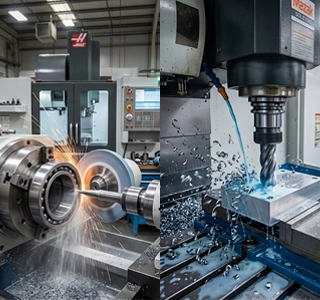
Modern manufacturing relies heavily on computer-controlled machining processes to produce accurate, consistent, and complex components. Among the most commonly used techniques are grinding and milling. Although both processes use CNC technology, they work in different ways and are suited to different manufacturing requirements. Understanding the differences between CNC grinding and milling can help manufacturers choose the right process based on material, component design, surface finish, dimensional accuracy, and production requirements.
What is CNC Grinding?
CNC grinding is a precision machining process that uses a rotating abrasive wheel to remove small amounts of material from a workpiece. Instead of cutting material with conventional teeth, the grinding wheel contains abrasive particles that gradually wear away the surface.
This process is particularly useful when extremely tight tolerances and excellent surface finishes are required. It is commonly used for finishing hardened metals and components that have already undergone other machining operations. Typical applications include:
- Shafts and cylindrical components
- Precision gears
- Bearings and bearing races
- Dies and molds
- Hardened machine parts
- Components requiring highly accurate dimensions
Because grinding removes material gradually, it is often selected for finishing rather than heavy material removal.
What is CNC Milling?
CNC milling uses computer-controlled rotating cutting tools to remove material from a workpiece. The cutting tool can move along multiple axes, allowing manufacturers to create slots, holes, pockets, contours, and complex three-dimensional shapes.
Unlike grinding, milling is generally capable of removing larger quantities of material more efficiently. Depending on the machine configuration, milling can be performed on materials such as aluminum, steel, stainless steel, plastics, and various engineering alloys. A CNC miling service in Sharjah can be useful for manufacturers looking to produce prototypes, machine components, custom parts, and production batches with consistent dimensions.
CNC Grinding versus CNC Milling: Major Differences
Although both processes are computer-controlled, their capabilities differ considerably.
- Cutting Method: The biggest difference is the way material is removed. Grinding uses abrasive particles attached to a wheel, while milling uses cutting edges on a rotating tool. Milling tools are generally designed for more aggressive material removal, whereas grinding is better suited to controlled finishing and precision correction.
- Material Removal Rate: Milling typically removes material faster than grinding. It can quickly transform a rough workpiece into a component that is close to its final shape. Grinding usually removes smaller quantities of material. Its strength lies in improving dimensional accuracy and surface quality after the main machining operations have been completed.
- Surface Finish: Grinding is widely recognized for producing very smooth and refined surfaces. This makes it suitable for components where surface roughness must be minimized. Milling can also produce excellent finishes, but the final result depends on factors such as cutting speed, feed rate, tool geometry, material, and machining strategy.
- Dimensional Accuracy: When components require extremely tight tolerances, grinding can provide an important finishing advantage. It can correct very small dimensional variations that may remain after previous machining processes. Milling also offers impressive accuracy, particularly with modern CNC equipment, but grinding is often preferred for final precision finishing.
- Component Geometry: Milling is highly versatile when creating complex geometries. It can machine pockets, slots, contours, drilled features, and irregular surfaces. Grinding is generally more specialized. Different grinding machines and wheels are used depending on whether the requirement involves cylindrical surfaces, flat surfaces, internal features, or specialized profiles.
- Tooling and Abrasives: Milling relies on cutting tools such as end mills, face mills, drills, and specialized cutters. Tool selection depends on the workpiece material and desired geometry. Grinding uses abrasive wheels made from materials such as aluminum oxide, silicon carbide, or other specialized abrasives. The wheel specification is selected according to the workpiece and required finish.
When Should You Choose Grinding?
Grinding is a strong option when the primary objective is precision finishing rather than significant material removal. It can be particularly valuable for hardened components, close-tolerance parts, and applications where surface quality is critical. For example, a manufacturer may first mill a component to establish its basic dimensions and geometry. Grinding can then be used to bring critical surfaces to their final tolerance and finish.
When is Milling the Better Choice?
Milling is usually preferable when a component requires substantial material removal or has a complex shape. It provides considerable flexibility and can often perform multiple operations within a single setup. For prototypes and production parts, selecting a reliable CNC miling service in Sharjah can help manufacturers achieve repeatable results while maintaining control over dimensions, tooling, and production requirements.
Can Grinding and Milling Be Used Together?
Yes. In many manufacturing environments, grinding and milling are complementary rather than competing processes. A typical production sequence could involve:
- Preparing the raw material.
- Rough milling to remove excess material.
- Precision milling to create the required geometry.
- Heat treatment where necessary.
- Grinding critical surfaces.
- Inspection and dimensional verification.
- Final finishing and quality checks.
This combined approach allows manufacturers to take advantage of the speed and flexibility of milling while using grinding for high-precision finishing.
Factors to Consider When Selecting a Process
Choosing between milling and grinding depends on the specific requirements of the manufacturing process. Factors such as the material being machined, required tolerances, desired surface finish, component geometry, production volume, and overall cost should all be considered before selecting a process. For example:
- Milling: Often a practical choice for complex components that require significant material removal and extensive shaping.
- Grinding: More suitable for hardened materials, precise dimensions, and applications requiring exceptionally tight tolerances and fine surface finishes.
- Both processes: In many manufacturing applications, milling and grinding can complement each other. Milling may be used for initial shaping and material removal, followed by grinding to achieve the required precision and surface finish.
Ultimately, manufacturers should evaluate the specific needs of each component rather than viewing milling and grinding as competing processes. Using both at different stages can often provide the right balance of efficiency, accuracy, and surface quality.
Both CNC grinding and CNC milling have important roles in modern precision manufacturing. Milling offers flexibility, efficient material removal, and the ability to create complex geometries, while grinding excels in precision finishing, tight tolerances, and smooth surfaces.
The right choice ultimately depends on the component’s design and performance requirements. By evaluating material, geometry, tolerance, surface finish, and production volume, manufacturers can select the machining process that delivers the best combination of quality, efficiency, and cost-effectiveness.