
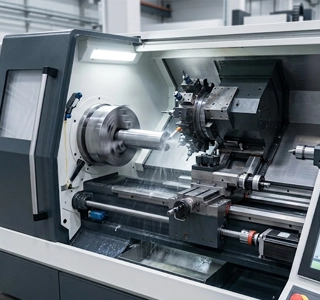
Modern manufacturing relies heavily on machines that can produce accurate, repeatable, and complex components. Among these, the CNC lathe machine is one of the most important tools used for turning cylindrical parts. Unlike traditional lathes, modern computer-controlled systems combine mechanical movement, digital programming, automated tooling, and advanced monitoring to achieve consistent results. Understanding how these machines work can help manufacturers, engineers, and product designers make better decisions when selecting machining processes.
What is a CNC Lathe Machine?
A CNC lathe is a computer-controlled machine designed primarily for rotating a workpiece while cutting tools remove material from its surface. The workpiece is secured in a chuck or another suitable holding device and rotated at a programmed speed. Cutting tools then move along specific axes to create the required shape and dimensions.
The machine follows instructions generated from a CNC program. These instructions control factors such as spindle speed, tool movement, cutting depth, feed rate, and machining sequence. This level of automation allows manufacturers to produce multiple components with a high degree of consistency.
Key Components of a Modern CNC Lathe
A modern CNC lathe consists of several interconnected mechanical and electronic systems. Each component has a specific role in ensuring accurate machining.
- Headstock and Spindle: The headstock contains the main spindle and drive mechanism. The spindle rotates the workpiece at a controlled speed, allowing the cutting tool to remove material efficiently. Modern machines can automatically adjust spindle speed according to the material, cutting operation, and programmed requirements. High-performance spindles also provide the stability required for demanding machining applications.
- Chuck and Workholding System: The chuck holds the workpiece securely while it rotates. Depending on the application, manufacturers may use three-jaw, four-jaw, collet, or specialized workholding systems. Proper workholding is essential because even a small amount of movement or misalignment can affect dimensional accuracy and surface finish.
- Cutting Tools: Cutting tools perform the actual material-removal operation. Common tools include turning inserts, boring tools, threading tools, grooving tools, and parting tools. Modern CNC lathes often use indexable carbide inserts because they can withstand high cutting temperatures and maintain their cutting performance during demanding operations. Tool geometry is selected according to the material and type of machining being performed.
- Carriage and Tool Turret: Traditional lathes use a carriage to move the cutting tool. Modern CNC machines commonly use an automated turret that can hold multiple tools. The turret can rotate to position the required tool automatically. This reduces manual intervention and allows several machining operations to be completed during a single setup.
- Control Panel: The control panel acts as the interface between the operator and the machine. Operators can enter programs, adjust machining parameters, monitor machine status, and diagnose certain errors through the control system. The controller interprets programmed instructions and converts them into precise machine movements.
How Does a Modern CNC Lathe Work?
The machining process generally begins with a digital drawing or 3D model of the required component. Manufacturing engineers use this information to develop a machining strategy and generate the appropriate CNC program.
Once the workpiece is secured, the operator loads the program into the machine. The spindle begins rotating the material at the specified speed. The turret positions the selected cutting tool, and the tool moves along programmed axes. During the operation, material is gradually removed through processes such as:
- Facing
- Turning
- Boring
- Grooving
- Threading
- Drilling
- Parting
The controller coordinates these movements with precise timing. Depending on the machine, automatic tool changers, coolant systems, probing devices, and chip management systems can further improve productivity.
The Role of CNC Programming
Programming is one of the most important aspects of modern CNC machining. A CNC program contains instructions that tell the machine exactly how the component should be produced. Programs can contain commands for tool positioning, spindle rotation, feed rates, cutting depths, and other machining parameters. Many manufacturers use CAD/CAM software to create toolpaths and convert digital designs into machine-readable instructions. Modern controllers can also support advanced features such as tool compensation, rigid tapping, multi-axis interpolation, and automated probing. These capabilities allow the machine to handle increasingly complex components.
How Automation Improves Production?
Automation is one of the major advantages of modern CNC lathe technology. Once the correct program, tools, and workholding system are established, the machine can produce components repeatedly with limited operator intervention. This is particularly valuable for batch production. Instead of manually adjusting the machine for every component, the CNC system can follow the same programmed sequence for each workpiece.
Automation can also reduce setup errors, improve productivity, and make production planning more predictable. When combined with automatic bar feeders or robotic loading systems, CNC lathes can operate for extended production cycles.
Precision and Quality Control
Precision is a fundamental requirement in modern manufacturing. CNC lathe machines use servo motors, linear guides, encoders, and feedback systems to control movement accurately. Some advanced machines also incorporate probing systems that measure workpieces or tools during the machining process. These measurements can help identify dimensional variations and support automatic compensation. Good results, however, depend on more than the machine itself. Tool condition, material properties, workholding, programming, machine calibration, and cutting parameters all influence the final component.
Why Are Modern CNC Lathes Important?
Modern CNC lathe technology has transformed the way manufacturers produce rotational components. Industries such as automotive, aerospace, medical equipment, oil and gas, electronics, and general engineering use these machines for producing components with demanding dimensional requirements.
The combination of computerized control and mechanical precision allows manufacturers to achieve repeatable results while reducing dependence on manual machining techniques. For companies handling complex or high-volume production, CNC Machining provides a practical way to improve consistency, productivity, and manufacturing efficiency. It also supports flexible production because the same machine can manufacture different components simply by changing the program, tooling, and setup.
A modern CNC lathe machine is much more than a computer-controlled version of a traditional lathe. Its spindle, workholding system, tool turret, servo drives, control system, and feedback mechanisms work together to transform raw material into precisely manufactured components.
As manufacturing requirements continue to evolve, advanced CNC Machining systems are becoming increasingly capable of handling complex geometries, tighter tolerances, and automated production requirements. Understanding the mechanics behind these machines makes it easier to appreciate how digital instructions are converted into precise physical movements. Ultimately, the effectiveness of CNC Machining depends on the combination of reliable equipment, appropriate tooling, accurate programming, skilled operation, and effective quality control.