
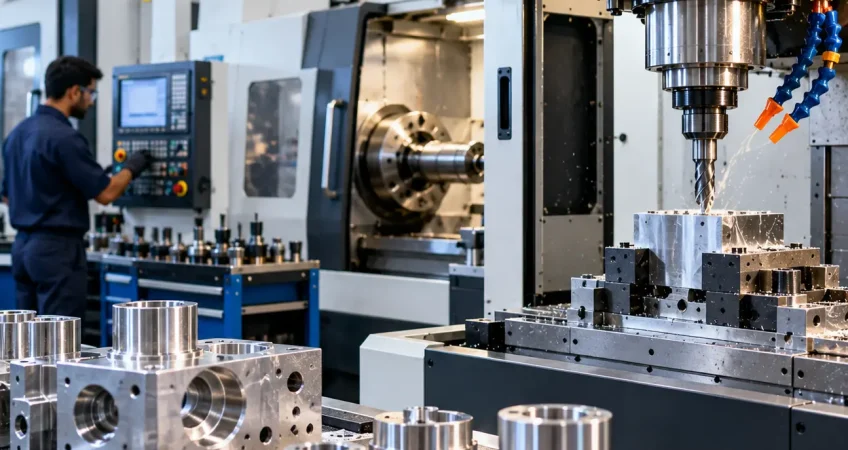
Dubai has become an important hub for manufacturing, engineering, fabrication, and industrial production in the UAE. As companies increasingly look for faster production, consistent quality, and complex component manufacturing, computer numerical control (CNC) machines have become an essential part of modern machining operations.
CNC technology allows manufacturers to control cutting tools and machining equipment through programmed instructions. This makes it possible to produce components with accurate dimensions, repeatable results, and complex geometries. Depending on the material, component design, production volume, and required tolerance, different CNC machines are used for different applications. Understanding the types of CNC machines in Dubai can help manufacturers, engineers, and procurement teams select the right equipment for their specific production requirements.
Essential CNC Machines Used in Precision Machining
Different CNC machines are designed to perform specific machining operations. While some are suitable for basic turning or milling, others are built for highly complex components and demanding industrial applications.
- CNC Milling Machines: CNC milling machines are among the most widely used machines in modern manufacturing. They use rotating cutting tools to remove material from a workpiece and create precise shapes, slots, holes, pockets, and contours. Depending on the machine configuration, milling can be performed along multiple axes. Three-axis machines are commonly used for relatively straightforward components, while four-axis and five-axis machines can produce more complicated geometries. CNC milling is widely used for:
- Metal components
- Machine parts
- Moulds and dies
- Automotive components
- Aerospace parts
- Industrial equipment
The ability to handle different materials and produce complex shapes makes milling machines highly versatile.
- CNC Turning Machines: CNC turning machines are designed primarily for producing cylindrical or round components. During the process, the workpiece rotates while a cutting tool removes material to achieve the required dimensions. These machines are suitable for manufacturing components such as:
- Shafts
- Bushings
- Pins
- Rollers
- Sleeves
- Threaded components
Modern CNC lathes can perform several operations, including facing, threading, grooving, boring, and drilling. Their high repeatability makes them useful for both prototypes and larger production runs.
- CNC Lathe Machines: Although CNC turning and CNC lathes are closely related, the term CNC lathe is commonly used for machines designed around traditional lathe operations with computer-controlled movement. These machines can maintain consistent dimensions across multiple components, which is particularly useful when manufacturers need large quantities of identical parts. Advanced CNC lathes may also incorporate automatic tool changers, live tooling, and additional axes to perform more complex operations without repeatedly moving the workpiece between machines.
- CNC Grinding Machines: Grinding machines are used when extremely accurate surface finishes and dimensional control are required. Instead of conventional cutting tools, they use abrasive wheels to remove small amounts of material. CNC grinding can be useful for components requiring:
- Tight dimensional tolerances
- Smooth surface finishes
- Accurate cylindrical shapes
- Precision edges
- Consistent finishing
Grinding is often used as a finishing operation after turning or milling. It is particularly valuable when the final component needs a high degree of dimensional accuracy.
- CNC Drilling Machines: CNC drilling machines are designed to create accurately positioned holes in different types of materials. Computer-controlled positioning allows manufacturers to maintain consistent hole locations across multiple components. Depending on the machine and tooling, drilling operations can include standard drilling, reaming, tapping, and counterboring. CNC drilling is commonly used for components that require multiple holes with precise spacing and alignment. It can also be integrated into machining centres to reduce the need for separate drilling operations.
- CNC 5-Axis Machining Centres: Five-axis CNC machines provide movement along multiple axes, allowing the cutting tool to approach a workpiece from different angles. This capability is particularly useful for components with complex surfaces and difficult geometries. Five-axis machining can reduce the number of setups required during production. Fewer setups can help improve accuracy because the component does not need to be repeatedly repositioned. These machines are commonly considered for:
- Aerospace components
- Medical parts
- Turbine components
- Complex moulds
- High-precision industrial parts
For demanding applications, Precision CNC machining Dubai companies may use five-axis technology when conventional three-axis equipment cannot efficiently achieve the required geometry or accuracy.
- CNC Router Machines: CNC routers use rotating tools to cut, shape, and engrave materials such as plastics, composites, wood, and certain non-ferrous metals. They are particularly useful for larger workpieces and applications involving cutting, profiling, engraving, and panel processing. While CNC routers are not always associated with heavy-duty metal machining, they can be highly effective for industries that work with lighter materials and require computer-controlled cutting.
- CNC Wire EDM Machines: Wire electrical discharge machining, commonly known as wire EDM, uses a thin electrically charged wire to cut conductive materials. The process does not rely on conventional mechanical cutting and is useful for producing intricate shapes and narrow slots. Wire EDM is especially valuable for hardened materials and components requiring intricate profiles. It is often used in tool and die manufacturing, mould production, aerospace applications, and other precision industries. One major advantage is its ability to create detailed shapes that may be difficult to produce using conventional cutting tools.
How to Select the Right CNC Machine?
Choosing a CNC machine should be based on more than its number of axes. Manufacturers need to consider the material, component geometry, tolerance requirements, production volume, surface finish, and available tooling. Important factors include:
- Material: Aluminium, stainless steel, titanium, brass, plastics, and other materials have different machining characteristics. The machine’s spindle power, tooling, and cutting capabilities should match the material being processed.
- Component Design: Simple cylindrical components may only require CNC turning, while complex three-dimensional parts could require multi-axis milling or five-axis machining.
- Required Tolerance: Components used in aerospace, medical, automotive, and other demanding industries may require extremely tight tolerances. The selected machine must be capable of maintaining the required accuracy consistently.
- Production Volume: A machine suitable for prototypes may not be the best choice for high-volume manufacturing. Automation, tool-changing systems, cycle time, and production efficiency become increasingly important as volumes increase.
- Surface Finish: If a component requires a very smooth surface, additional operations such as grinding may be necessary after milling or turning.
Why CNC Technology Matters in Dubai’s Manufacturing Sector?
Dubai’s diverse industrial environment includes engineering, construction, automotive, aerospace, marine, oil and gas, and general manufacturing applications. Each sector may require different types of machined components.
CNC technology helps manufacturers produce repeatable components while reducing dependence on manual machining. Computer-controlled processes can also make it easier to reproduce a design accurately once the program and tooling have been properly established.
For businesses seeking Precision CNC machining Dubai, the choice of machine should therefore be based on the specific requirements of the component rather than simply selecting the most advanced equipment available.
CNC machining has transformed the way precision components are manufactured by combining computer-controlled movement with advanced cutting and finishing technologies. From milling and turning to grinding, five-axis machining, and wire EDM, each machine type offers distinct capabilities.
Understanding the types of CNC machines in Dubai makes it easier for manufacturers to match machining technology with their material, design, tolerance, and production requirements. With the right machine, tooling, programming, and quality controls, manufacturers can achieve consistent results across prototypes, small batches, and large-scale production. For companies planning precision CNC machining Dubai projects, evaluating machine capabilities, material compatibility, accuracy, production volume, and finishing requirements is an important step toward achieving reliable and cost-effective results.