
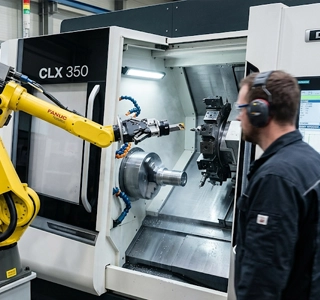
The manufacturing industry is evolving rapidly, and one of the most significant transformations is the integration of robotics into CNC turning operations. What was once a manual and labor-intensive process is now becoming faster, smarter, and more efficient. Robotics is not just enhancing productivity, rather it is redefining how precision components are produced across industries. In today’s competitive landscape, businesses are constantly looking for ways to improve accuracy, reduce costs, and scale operations. This is where robotics plays a vital role in modern CNC turning.
Understanding CNC Turning
CNC (Computer Numerical Control) turning is a machining process where a cutting tool removes material from a rotating workpiece to create precise cylindrical parts. It is widely used in industries such as automotive, aerospace, medical, and electronics due to its ability to produce complex shapes with high accuracy.
Traditionally, CNC turning required skilled operators to handle tasks like loading raw materials, monitoring the machine, and inspecting finished parts. While effective, this approach had limitations in terms of speed, consistency, and labor efficiency.
The Role of Robotics in CNC Turning
Robotics has introduced a new level of automation to CNC turning operations. Robots can now handle repetitive and time-consuming tasks with precision and consistency, allowing human operators to focus on more strategic activities. Common robotic applications in CNC turning include:
- Material Loading and Unloading: Robots automatically load raw materials into the CNC machine and remove finished parts, reducing manual effort and speeding up production.
- Tool Handling and Changeovers: Robotic systems assist in quick and precise tool changes, minimizing downtime and improving machining efficiency.
- Quality Inspection: Robots equipped with sensors and cameras can inspect parts in real-time, ensuring consistent quality and reducing defects.
- Material Handling and Sorting: They organize, move, and sort components efficiently within the production line, improving workflow and reducing bottlenecks.
- Process Consistency: Robots perform repetitive tasks with high precision, ensuring uniform results across large production batches.
- Continuous Operation: Unlike manual labor, robots can work 24/7 without fatigue, significantly increasing productivity.
By automating these tasks, manufacturers can significantly reduce human error and increase overall efficiency.
Types of Robots Used in CNC Turning
Different types of robots are used depending on the application:
- Articulated Robots: These are highly flexible and can perform complex movements, making them ideal for machine tending and multi-step operations.
- Collaborative Robots (Cobots): Designed to work safely alongside humans, cobots are perfect for small and medium-scale operations.
- SCARA Robots: Known for their speed and precision, they are commonly used for repetitive, high-speed tasks.
Choosing the right robot depends on production requirements, workspace, and complexity of operations.
Key Benefits of Robotics in CNC Turning
- Increased Productivity: Robots can operate continuously without fatigue, enabling 24/7 production and significantly increasing output.
- Improved Accuracy: Automation reduces human error, ensuring consistent quality and precision in every component produced.
- Enhanced Safety: Robots handle hazardous tasks, minimizing risks for workers and creating a safer work environment.
- Reduced Labor Costs: By automating repetitive tasks, businesses can optimize workforce allocation and reduce dependency on manual labor.
- Faster Cycle Times: Robotic systems streamline operations, reducing downtime and improving turnaround times.
Many manufacturers partnering with the best CNC machine company are leveraging these benefits to stay competitive in a rapidly evolving market.
Real-World Applications
Robotics in CNC turning is widely used across multiple industries:
- Automotive: Production of engine components, shafts, and gears
- Aerospace: High-precision parts with tight tolerances
- Medical: Manufacturing of surgical instruments and implants
- Electronics: Small, intricate components for devices
These applications highlight how robotics is enabling manufacturers to meet high demand without compromising quality.
Challenges and Limitations
While robotics offers numerous advantages, there are some challenges to consider:
- High Initial Investment: Setting up robotic systems can be expensive initially
- Integration Complexity: Combining robots with existing CNC machines requires careful planning
- Skill Requirements: Operators need training to manage and maintain automated systems
- Maintenance Needs: Regular servicing is essential to ensure smooth operation
Despite these challenges, the long-term benefits often outweigh the initial hurdles.
Robotics versus Manual CNC Turning
A comparison between robotic and manual operations highlights the difference:
- Efficiency: Robotic CNC turning operates continuously with minimal downtime, while manual operations depend on human availability and shifts.
- Accuracy: Robots deliver consistent precision in every cycle, whereas manual processes may vary due to human error.
- Productivity: Automation significantly increases output by handling repetitive tasks faster than manual labor.
- Labor Dependency: Robotic systems reduce reliance on skilled operators for routine tasks, while manual CNC requires constant human involvement.
- Safety: Robots handle hazardous operations, reducing workplace risks compared to manual handling.
- Scalability: Robotic setups can be easily scaled for higher production demands, whereas manual operations are harder to expand efficiently.
- Initial Cost vs Long-Term Savings: Robotics requires higher upfront investment but offers long-term cost savings, while manual setups have lower initial costs but higher ongoing expenses.
This shift is why many manufacturers are turning to the Best cnc machine company for advanced automation solutions.
Future Trends in Robotic CNC Turning
The future of CNC turning is closely tied to technological advancements:
- Artificial Intelligence (AI) Integration: AI enables machines to optimize cutting parameters, detect errors, and improve efficiency without constant human intervention.
- Industry 4.0 and Smart Factories: Fully connected systems allow CNC machines and robots to communicate, creating automated and data-driven production environments.
- IoT-Enabled Monitoring: Sensors and connected devices provide real-time data on machine performance, helping operators track productivity and detect issues early.
- Predictive Maintenance: Advanced analytics can predict potential failures before they happen, reducing downtime and maintenance costs.
- Digital Twins: Virtual replicas of machines and processes allow manufacturers to simulate, test, and optimize operations before implementing them in real life.
- Collaborative Robotics (Cobots): Safer and more flexible robots will increasingly work alongside humans, improving efficiency without replacing human expertise.
These innovations are set to make CNC turning even more efficient and intelligent.
How to Implement Robotics in CNC Turning?
For businesses looking to adopt robotics, a strategic approach is essential:
- Assess Production Needs: Evaluate your current workflow, production volume, and bottlenecks to determine where robotics can add the most value.
- Choose the Right Robot Type: Select robots (articulated, cobots, SCARA) based on task complexity, speed, and workspace requirements.
- Plan System Integration: Ensure the robot can seamlessly integrate with existing CNC machines, software, and tooling setups.
- Invest in Training: Equip your workforce with the skills needed to operate, program, and maintain robotic systems effectively.
- Start with Pilot Projects: Begin with a small-scale implementation to test performance and identify improvements before full deployment.
- Monitor and Optimize Performance: Continuously track productivity, quality, and downtime to refine processes and maximize efficiency.
Collaborating with the best CNC machine company can help streamline this process and ensure successful implementation.
Robotics is transforming CNC turning operations in ways that were unimaginable just a few years ago. From improving productivity and accuracy to enabling round-the-clock manufacturing, automation is setting new standards in the industry.
While the transition may require investment and planning, the long-term advantages make it a worthwhile move for any forward-thinking manufacturer. As technology continues to evolve, robotics will play an even bigger role in shaping the future of CNC turning, making operations smarter, faster, and more efficient than ever before.