
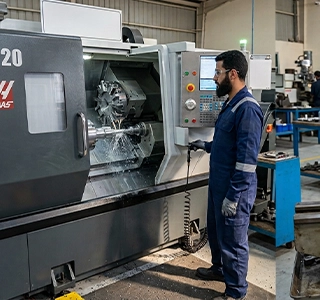
Turning is one of the most widely used machining processes for producing cylindrical and rotational components. While traditional manual turning has been used for decades, CNC turning has become increasingly common in modern manufacturing because of its ability to deliver consistent results, faster production, and precise dimensions. Both methods have their place in machining, but understanding their differences can help manufacturers choose the right process for a particular application.
What is CNC Turning?
CNC turning uses computer-controlled machines to remove material from a rotating workpiece. The cutting tool follows programmed instructions to create the required dimensions, shapes, grooves, threads, and other features. Once the program is prepared and the machine is properly set up, the process can be repeated with minimal manual intervention.
CNC turning is suitable for producing components from materials such as aluminium, steel, brass, stainless steel, titanium, and various engineering plastics. It is commonly used for automotive components, industrial machinery parts, aerospace components, shafts, bushings, fittings, and other precision-engineered products. For companies handling demanding production requirements, CNC Turning Services UAE can provide access to computer-controlled machining capabilities without requiring them to maintain their own CNC equipment.
What is Manual Turning?
Manual turning is performed using a conventional lathe that requires an operator to control the cutting tool and machining parameters. The operator adjusts the feed, speed, depth of cut, and tool movement according to the component drawing and machining requirements.
Manual lathes are useful for repair work, maintenance activities, prototypes, one-off components, and simple machining tasks. They also allow experienced machinists to make adjustments during the process based on their observations of the workpiece and cutting conditions. However, manual turning generally requires more direct operator involvement than CNC machining, particularly when producing multiple components or parts with complex geometries.
Key Advantages of CNC Turning
- Higher Precision and Consistency: One of the major advantages of CNC turning is its ability to maintain consistent dimensions across multiple components. Once the machining program and tooling are correctly established, the machine can reproduce the same movements and cutting sequences repeatedly. This is particularly useful when components need to meet tight dimensional requirements or when several parts must fit together during assembly.
- Faster Production: CNC turning can reduce production time, especially when manufacturing batches of identical components. After the initial programming and setup, the machine can perform many machining operations automatically. This reduces the need for continuous manual tool movement and allows operators to focus on monitoring the process, inspecting components, and managing other production activities.
- Better Repeatability: Repeatability is important when producing large quantities of the same component. Manual machining can introduce variations because results may depend on the operator’s technique and adjustments. CNC machines follow programmed instructions, helping produce parts with consistent dimensions from one cycle to another. This makes CNC turning particularly suitable for batch production.
- Ability to Produce Complex Components: CNC turning can handle a wide range of geometries and machining operations. Depending on the machine configuration, it can produce tapers, threads, grooves, bores, contours, and other detailed features. Multi-axis CNC turning equipment can also perform additional operations, reducing the need to transfer a component between different machines.
- Reduced Manual Intervention: Once the machine has been programmed and set up, many machining operations can be performed with limited direct intervention. This can improve workflow efficiency and reduce the amount of repetitive manual work required from operators. For manufacturers dealing with regular production orders, this can make the overall machining process more streamlined.
Key Advantages of Manual Turning
- Suitable for Small Quantities: Manual turning can be practical when only one or a few components are required. Programming and CNC setup may not always be worthwhile for a simple one-off job. For repair workshops and maintenance departments, a conventional lathe can provide a practical way to produce replacement parts quickly.
- Useful for Prototyping: When developing a new component, machinists may need to make frequent adjustments to dimensions or cutting operations. Manual turning allows an experienced operator to make these changes directly during machining. This flexibility can be useful during early-stage prototyping and experimental work.
- Lower Initial Equipment Complexity: Manual lathes generally have simpler controls and operating systems compared with CNC equipment. They do not require CNC programming infrastructure, although skilled operators are essential for achieving accurate results. For workshops handling basic turning tasks, manual equipment may therefore be suitable for certain applications.
CNC Turning vs Manual Turning: Which Should You Choose?
The right choice depends on factors such as component complexity, production volume, dimensional requirements, available budget, and turnaround time.
CNC turning is generally more suitable for high-volume production, complex geometries, repeat orders, and components requiring consistent dimensions. Manual turning can be appropriate for repairs, prototypes, simple parts, and low-volume requirements where flexibility and quick adjustments are important. Manufacturers should also consider material type, component size, tolerances, surface finish, tooling requirements, and inspection requirements before selecting a machining method.
The Role of Professional CNC Machining
Choosing the right machining process is only one part of achieving a reliable finished component. Proper machine setup, cutting-tool selection, workholding, programming, inspection, and quality control can all affect the final result. Businesses that do not have in-house CNC equipment can work with experienced machining providers for their component requirements. CNC Turning Services UAE can support industries that require accurately machined parts while providing access to suitable machinery, technical expertise, and production capabilities.
Before placing an order, it is useful to provide detailed drawings, material specifications, required quantities, dimensional tolerances, surface-finish requirements, and delivery expectations. Clear technical information helps the machining provider understand the application and determine the appropriate production method.
CNC turning and manual turning both offer useful advantages, but they serve different manufacturing needs. Manual turning remains valuable for prototypes, repairs, simple components, and small production runs, while CNC turning offers greater automation, repeatability, precision, and efficiency for demanding production requirements.
For businesses producing complex or repetitive components, selecting an experienced machining partner can help ensure that the chosen process matches the technical requirements of the project. CNC Turning Services UAE can be considered when consistent, computer-controlled machining is required for precision components and production applications.