
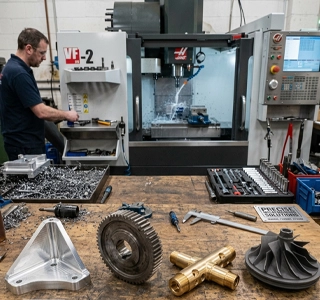
Choosing the right material is one of the most important decisions when planning a precision manufacturing project. The material affects machining speed, tool life, surface finish, component strength, weight, cost, and final performance. While aluminium, steel, brass, and titanium are all widely used, each one behaves differently during machining and is better suited to particular applications.
Understanding the strengths and limitations of different CNC machining materials helps manufacturers select an option that balances performance, durability, appearance, and production cost. This guide compares four commonly used metals and explains where each material works best.
Aluminium: Lightweight and Easy to Machine
Aluminium is one of the most popular choices for precision components because it combines low weight with good machinability. It is relatively soft compared with steel and titanium, allowing cutting tools to remove material efficiently and helping manufacturers achieve shorter production cycles.
Key Properties
- Lightweight with a high strength-to-weight ratio
- Good corrosion resistance
- Excellent thermal and electrical conductivity
- Relatively easy to cut and shape
- Available in several grades and alloys
Applications
Aluminium is commonly used for automotive components, electronic housings, aerospace parts, machine frames, brackets, enclosures, heat sinks, and prototypes. Its attractive appearance and compatibility with anodising also make it useful for consumer and architectural products.
Advantages
The biggest benefit is machinability. Aluminium can generally be processed quickly without placing excessive demands on cutting tools. Its low density also makes it ideal when reducing component weight is important.
Limitations
Aluminium is not the best choice for applications requiring extremely high hardness or wear resistance. Some softer grades can also be prone to deformation or surface damage when subjected to heavy loads.
Suitable Applications
Aluminium works particularly well for lightweight housings, brackets, prototypes, electronic components, aerospace structures, and parts requiring efficient heat dissipation.
Steel: Strength and Durability
Steel offers a broad range of grades, making it suitable for everything from general-purpose components to highly demanding industrial parts. Its strength, toughness, and wear resistance make it a dependable option when durability is more important than minimum weight.
Key Properties
- High strength and toughness
- Good wear resistance
- Available in numerous grades
- Suitable for heat treatment
- Strong performance under heavy loads
Applications
Steel is frequently used for gears, shafts, machine components, fixtures, automotive parts, industrial tools, structural components, and heavy-duty equipment. Stainless steel grades are also selected when corrosion resistance and hygiene are important.
Advantages
One of steel’s main advantages is versatility. Different grades can provide specific combinations of hardness, strength, corrosion resistance, and machinability. Heat treatment can further improve the mechanical properties of suitable grades.
Limitations
Steel is considerably heavier than aluminium. Some hardened and high-strength grades can also be challenging to machine, increasing cutting forces and accelerating tool wear. Selecting the correct tooling and machining parameters is therefore important.
Suitable Applications
Steel is well suited to shafts, gears, brackets, tooling, fixtures, automotive components, machine parts, and components exposed to substantial mechanical loads.
Brass: Excellent Machinability and Appearance
Brass is an alloy primarily made from copper and zinc. It is valued for its excellent machinability, attractive golden appearance, and useful combination of strength and corrosion resistance.
Key Properties
- Excellent machinability
- Good corrosion resistance
- Good electrical conductivity
- Attractive surface appearance
- Low friction characteristics in suitable applications
Applications
Brass is commonly found in valves, fittings, connectors, electrical components, plumbing hardware, decorative parts, and precision instruments. It is particularly useful for components requiring numerous drilled, threaded, or turned features.
Advantages
Brass is comparatively easy to machine and can produce clean surfaces with well-defined details. Its good dimensional stability and attractive appearance make it useful for both functional and decorative components.
Limitations
Brass generally does not provide the same strength-to-weight performance as some engineering steels or titanium alloys. Certain brass compositions may also have environmental or application-specific considerations that need to be evaluated before production.
Suitable Applications
Brass is an excellent choice for fittings, valves, electrical connectors, threaded components, instrument parts, decorative hardware, and components where machinability is a major consideration.
Titanium: High Performance with Low Weight
Titanium is often selected for demanding applications where high strength, low density, and corrosion resistance are required. It offers an impressive strength-to-weight ratio, but its machining characteristics are more demanding than those of aluminium or brass.
Key Properties
- High strength-to-weight ratio
- Low density compared with steel
- Excellent corrosion resistance
- Strong performance at elevated temperatures
- Good biocompatibility for suitable grades
Applications
Titanium is widely used in aerospace components, medical implants and instruments, chemical-processing equipment, marine components, and high-performance engineering applications.
Advantages
Titanium provides excellent mechanical performance without adding as much weight as steel. It can also withstand aggressive environments and maintain useful properties under demanding operating conditions.
Limitations
The material’s low thermal conductivity means heat can remain concentrated near the cutting zone. Titanium can also react with cutting tools and requires careful control of cutting speeds, feeds, cooling, and tooling. These factors can increase machining time and production costs.
Suitable Applications
Titanium is particularly suitable for aerospace parts, medical components, high-performance automotive parts, marine equipment, and components exposed to corrosion or demanding mechanical conditions.
Aluminium versus Steel versus Brass versus Titanium
Each material brings a different combination of performance characteristics. Aluminium is generally preferred when low weight and easy machining are priorities. Steel is suitable when strength, toughness, and durability are essential. Brass stands out for machinability, dimensional accuracy, and appearance, while titanium is selected for demanding applications requiring high strength, corrosion resistance, and low weight.
|
Main Strength | Machinability | Weight | Common Applications | |||
| Aluminium | Lightweight and versatile | Excellent | Low | Aerospace, electronics, automotive | |||
| Steel | Strength and durability | Moderate to good, depending on grade | High | Gears, shafts, machinery | |||
| Brass | Machinability and appearance | Excellent | Medium | Fittings, connectors, valves | |||
| Titanium | Strength-to-weight ratio | Challenging | Low to medium | Aerospace, medical, marine |
How to Choose the Right Material?
Selecting the right material depends on more than just strength or cost. The component’s intended use, working environment, required lifespan, weight, and manufacturing requirements should all be considered before making a decision. A material that works well for one application may not be suitable for another. When comparing different options, consider these key factors:
- Strength: Choose a material that can withstand the expected loads and stresses.
- Weight: Aluminium or titanium may be suitable when reducing component weight is important.
- Corrosion Resistance: Consider materials that can withstand moisture, chemicals, or harsh environments.
- Machinability: Materials that are easier to machine can help reduce production time and tool wear.
- Temperature Resistance: For high-temperature applications, select a material that can maintain its properties under heat.
- Cost: Consider both the material price and the machining costs involved in producing the component.
The specific alloy or grade should also be considered, as properties can vary significantly within the same material family. By evaluating performance requirements alongside production needs, manufacturers can select a material that delivers the right balance of quality, durability, and cost.
The Role of Machining Requirements
Material selection should also be considered alongside the production process. Tool selection, cutting parameters, coolant strategy, workholding, tolerances, and required surface finish can all influence the final result.
For example, aluminium can often be machined at higher speeds, while titanium requires more controlled conditions to manage heat and tool wear. Steel may require different tooling depending on its hardness, whereas brass generally allows efficient production of detailed components.
For manufacturers, understanding these differences is essential when selecting CNC machining processes for a particular component. The right combination of material, tooling, and machining strategy can improve productivity while maintaining the required quality.
Aluminium, steel, brass, and titanium each have a valuable place in modern manufacturing. There is no single material that is ideal for every component. The right choice depends on the balance between strength, weight, machinability, corrosion resistance, durability, appearance, and cost.
By comparing the properties, applications, advantages, and limitations of each option before production begins, manufacturers can make more informed material decisions. A carefully selected material not only supports the performance of the finished component but can also influence machining efficiency, tool life, production time, and overall project cost.