
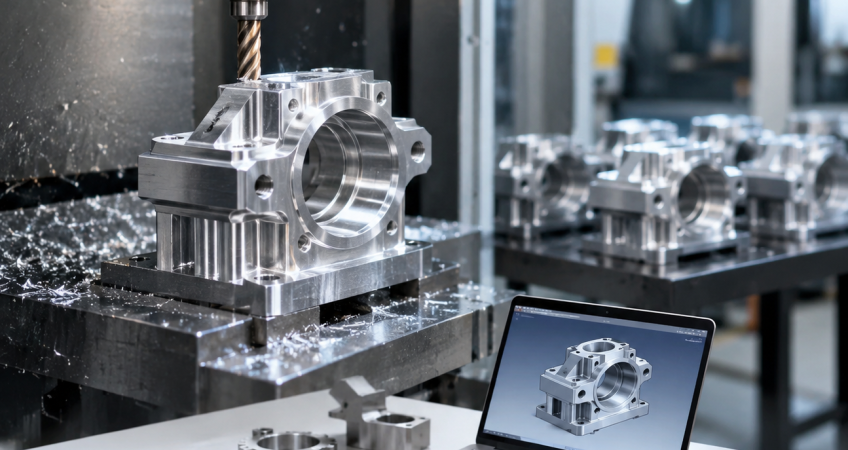
Scaling a manufacturing business requires more than increasing production volume. Companies must maintain quality, control costs, shorten development cycles and respond quickly to changing customer requirements. This becomes especially important when a product moves from an initial prototype to regular production.
CNC machining services can support this transition by providing a practical manufacturing route for developing, testing and producing precision components. From the first prototype to larger production batches, CNC technology offers consistency and flexibility while allowing manufacturers to refine designs without completely changing their production approach.
Why the Prototype-to-Production Journey Matters?
A prototype allows engineers and product teams to evaluate a design before committing to larger manufacturing volumes. It can reveal issues with dimensions, material selection, assembly, functionality and overall performance. However, producing a successful prototype is only the beginning. The manufacturing process must also support the requirements of commercial production. A product that works well as a prototype may still require adjustments before scaling. Tooling requirements, machining time, material consumption, tolerances and inspection procedures all need consideration. A well-planned transition reduces unnecessary redesigns and helps businesses move from development to production with greater confidence.
How CNC Machining Supports Product Development?
CNC machining removes material from a workpiece according to programmed instructions. This allows manufacturers to produce components with precise dimensions and repeatable results.
For prototype development, this flexibility is particularly useful. Engineers can modify a digital design, manufacture another component and evaluate the revised version without creating permanent production tooling. This approach can be valuable for industries producing:
- Automotive components
- Industrial equipment
- Aerospace parts
- Medical devices
- Electronics housings
- Oil and gas equipment
- Custom mechanical assemblies
The same basic machining principles can then be adapted as the product moves toward production.
From Prototype to Production: A Structured Transition
- Start with Design Requirements: Before machining begins, manufacturers need a clear understanding of the component’s intended application. Dimensions, material, tolerances, surface finish and operating conditions should be defined at the design stage. A detailed technical drawing and suitable CAD model can help machinists understand the component accurately. Early communication between engineers and the machining team can also identify manufacturing challenges before production begins.
- Produce and Evaluate the Prototype: The first machined component provides an opportunity to test the design under real conditions. Measurements can be compared with engineering drawings, while functional testing can identify problems that may not be visible on a computer model. If modifications are required, the design can be adjusted before larger quantities are manufactured.
- Refine the Manufacturing Process: Once the prototype meets the required specifications, attention can shift toward production efficiency. Machining operations can be reviewed to determine:
- Suitable cutting tools
- Workholding methods
- Machining sequences
- Cutting parameters
- Inspection requirements
- Material handling procedures
The objective is not simply to manufacture the same component repeatedly. The process should also provide consistent quality within commercially practical production times.
- Maintaining Precision as Volume Increases: Production scaling can introduce challenges that are less noticeable during prototype development. When hundreds or thousands of components are required, even a small variation can affect assembly, performance or product reliability. This is where Precision machining services Dubai can provide value for businesses that require close dimensional control. Suitable CNC equipment, inspection methods and experienced machining personnel can help maintain consistency across production batches. Quality control should cover critical dimensions, surface finishes and other specifications relevant to the component.
- Choosing Materials for Scaled Production: Material selection affects machining performance, component durability and production cost. Aluminium, stainless steel, brass, titanium and engineering plastics may each suit different applications. However, the easiest material to machine is not always the best choice for the finished product. Engineers should consider:
- Strength requirements
- Corrosion resistance
- Operating temperature
- Weight
- Wear resistance
- Material availability
- Machining cost
Testing the selected material during prototype development can help identify potential manufacturing issues before production volumes increase.
- Reducing Production Delays: A reliable manufacturing process can help businesses manage delivery schedules more effectively. When the prototype and production stages use compatible machining methods, manufacturers can avoid unnecessary process changes. Existing programs, tooling strategies and inspection procedures can also provide a useful foundation for repeat production.This does not mean every prototype process should be copied directly into mass production. Instead, the prototype stage should provide information that can be used to create a more efficient production workflow.
- Supporting Different Production Volumes: One of the advantages of CNC machining is its suitability for different production requirements. A business may initially need only a few prototype components. Later, it may require small production batches, replacement parts or larger quantities. CNC machining services can accommodate these changing requirements by adjusting machining schedules, tooling arrangements and production planning. This flexibility is particularly useful for companies whose demand is still developing. Businesses can increase production gradually instead of investing in dedicated tooling before market demand has been established.
Improving Communication Between Engineering and Manufacturing Teams
Successful scaling also depends on communication. Engineers understand product functionality, while machinists understand manufacturing limitations and process requirements. Bringing these perspectives together early can help identify problems before they become costly production issues. Manufacturers should discuss:
- Tolerance requirements
- Critical dimensions
- Material specifications
- Surface finish
- Production quantities
- Inspection procedures
- Expected delivery schedules
Clear documentation also reduces the risk of misunderstandings when production moves between development and manufacturing teams.
The Role of Inspection and Quality Control
Quality control becomes increasingly important as production volumes rise. During prototype development, engineers may inspect individual components in detail. For production, inspection procedures need to be structured so that quality remains consistent without creating unnecessary delays. Depending on the component, manufacturers may use precision measuring equipment, coordinate measuring machines and other inspection tools. A defined inspection process can help identify dimensional variations early and prevent non-conforming components from moving further through production.
Planning for Long-Term Production
Scaling should be considered from the beginning of product development rather than after the prototype has been approved. Design teams can review whether a component is practical to manufacture repeatedly, whether its tolerances are appropriate and whether its material is readily available. Working with precision machining services Dubai providers during the development stage can also help businesses evaluate production considerations before finalising a design. This approach can reduce late-stage modifications and create a clearer path toward repeat manufacturing.
Build a Scalable Manufacturing Strategy
Moving from prototype to production is a critical stage in a product’s development. Businesses need to balance engineering requirements, production efficiency, quality control and commercial considerations. CNC machining provides a flexible manufacturing route that can support this progression. By combining accurate prototyping, process refinement, material planning and structured inspection, companies can establish a stronger foundation for production growth. The key is to treat the prototype not simply as a finished sample, but as an opportunity to understand how the product will be manufactured consistently at scale.