
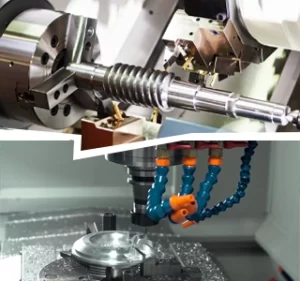
In precision manufacturing, surface finish is more than just visual appeal—it directly affects component performance, assembly accuracy, durability, and friction behavior. Whether a part must slide smoothly, seal tightly, or resist wear, its surface roughness plays a crucial role in how it functions over time. For buyers sourcing parts from CNC machine companies in UAE, understanding surface finish helps ensure the final component meets both functional and aesthetic requirements. Two of the most common processes used in CNC Cutting and precision manufacturing are CNC milling and CNC turning. While both fall under the umbrella of CNC Machining services, they produce surface textures in fundamentally different ways due to tool motion, geometry, and cutting mechanics. Buyers often assume one process always produces a better finish than the other, but the truth depends on part shape, material, and machining parameters. This post explains the differences between CNC milling and CNC turning surface finishes, the factors that influence them, and how buyers can specify the right finish for their applications.
What is Surface Finish in CNC Machining?
Surface finish refers to the microscopic texture of a machined surface, typically measured using the Ra value (roughness average). Ra represents the average height variation of surface peaks and valleys across a measured length.
In simple terms, surface roughness describes how smooth or rough a machined surface feels and behaves. Even surfaces that appear polished to the naked eye still contain microscopic tool marks created during machining.
Common Industrial Surface Finish Ranges
Typical achievable finishes in CNC machining include:
- Ra 3.2–6.3 µm – Standard machined finish
- Ra 1.6–3.2 µm – Fine machining finish
- Ra 0.8–1.6 µm – Precision machining
- Ra 0.2–0.8 µm – High-precision or ground finish
- Ra <0.2 µm – Polished or superfinished
Selecting the correct Ra value is essential. Over-specifying increases cost unnecessarily, while under-specifying can lead to functional failure.
Surface Finish in CNC Milling
CNC milling creates surfaces using a rotating multi-point cutting tool that moves across a stationary workpiece. Because the tool follows programmed paths, the resulting surface pattern depends heavily on tool engagement and motion strategy.
Tool Path Patterns
In milling, the cutter moves in linear or curved paths, leaving overlapping scallop marks. The spacing and orientation of these marks define the final texture. Common patterns include parallel passes, contour milling, and spiral tool paths. Surface finish improves when the tool path overlap is high and scallop height is minimized.
Cutter Type
The number of flutes, coating, and geometry of the milling cutter strongly influence finish quality. Finishing end mills with sharp edges and higher flute counts produce smoother surfaces compared to roughing tools. Ball-nose and radius cutters are often used for 3D contours to reduce visible tool marks.
Step-Over and Feed Rate
Step-over (the lateral distance between tool passes) is one of the most critical factors in milling finish. Smaller step-over values reduce scallop height and improve smoothness. Similarly, lower feed rates allow the cutter to remove thinner chips, resulting in finer surfaces.
Machine Rigidity
Vibration and chatter are major enemies of milling finish. A rigid machine structure, stable fixturing, and balanced tooling are essential for achieving smooth surfaces. Even slight deflection can create waviness or tool marks.
Typical Achievable Ra in Milling
- Standard milling: Ra 3.2–6.3 µm
- Fine milling: Ra 1.6–3.2 µm
- High-precision finishing: Ra 0.8–1.6 µm
Where Milling Performs Best
CNC milling excels in producing high-quality finishes on:
- Flat surfaces: CNC milling produces uniform, level finishes on flat faces because the cutter moves in controlled planar paths with consistent tool engagement.
- Complex 3D contours: Multi-axis milling can follow curved geometries and sculpted shapes accurately, making it ideal for molds, dies, and aerospace surfaces.
- Pockets and cavities: Milling tools can plunge and traverse inside enclosed areas, creating precise internal features that turning cannot produce.
- Mold and die surfaces: Ball-nose and radius cutters in finishing passes generate smooth, continuous surfaces required for injection molds and forming dies.
Prismatic components: Parts with flat faces, slots, steps, and angular features are best machined by milling because the process handles non-rotational geometries efficiently.
Because milling tools can approach from multiple directions, it is ideal for parts with varied geometries rather than rotational symmetry.
Surface Finish in CNC Turning
CNC turning uses a single-point cutting tool to remove material from a rotating work piece. This continuous cutting motion produces a fundamentally different surface texture compared to milling.
Continuous Cutting Motion
In turning, the tool remains in constant contact with the rotating part, creating a continuous spiral tool mark. This uninterrupted engagement naturally produces smoother and more uniform surfaces than intermittent milling cuts.
Tool Nose Radius Impact
The nose radius of the turning insert directly determines surface finish quality. Larger nose radii produce smoother surfaces because they flatten the feed marks left on the surface. However, excessively large radii can cause chatter if machine rigidity is insufficient.
Feed Rate Influence
Feed rate is the dominant factor in turning finish. Lower feed per revolution reduces the height of feed marks, producing finer Ra values. Finishing passes often use very small feeds specifically to improve surface quality.
Superior Cylindrical Finish Quality
Because turning inherently follows the rotational axis of the part, it produces exceptionally smooth cylindrical surfaces. This makes it the preferred process for shafts, pins, rollers, and sealing surfaces.
Typical Achievable Ra in Turning
- Standard turning: Ra 1.6–3.2 µm
- Fine turning: Ra 0.8–1.6 µm
- Precision turning: Ra 0.4–0.8 µm
Where Turning Produces Smoother Results
CNC turning is superior for:
- Cylindrical diameters: Continuous rotation during turning creates uniform spiral tool marks, producing smoother and more consistent finishes on round surfaces than milling.
- Bearing seats: Turning achieves precise diameter control and fine Ra values, ensuring proper fit and minimal friction for bearing mounting surfaces.
- Sealing surfaces: The process produces highly concentric and smooth finishes essential for O-ring, hydraulic, and fluid sealing interfaces.
- Rotational components: Shafts, pins, and rollers benefit from turning’s continuous cut, which minimizes surface waviness and ensures balanced rotation.
- Concentric features: Turning maintains excellent coaxial alignment between diameters, resulting in smooth transitions and superior finish across stepped cylindrical features.
In many cases, turning can achieve smoother cylindrical finishes than milling without secondary polishing.
Factors That Affect CNC Surface Finish
Regardless of process, several variables influence surface quality in CNC Machining services.
- Material Type: Harder materials like stainless steel or titanium tend to produce rougher finishes due to higher cutting forces. Softer materials like aluminum often yield smoother surfaces, although they may smear if tools are dull.
- Tool Sharpness: Worn or chipped tools create tearing rather than clean cutting, dramatically increasing roughness. Maintaining sharp finishing tools is essential for high-quality surfaces.
- Cutting Parameters: Feed rate, spindle speed, and depth of cut directly affect surface formation. Finishing passes typically use high speed, low feed, and shallow depth to minimize tool marks.
- Coolant Use: Coolant reduces heat, friction, and built-up edge formation. This improves surface integrity and prevents tearing or micro-welding on the surface.
- Machine Stability: Machine rigidity, spindle accuracy, and vibration control determine whether a smooth theoretical finish is actually achieved. Even ideal parameters cannot compensate for unstable equipment.
- Operator Programming: CAM strategy and toolpath optimization play a major role in milling finishes. Skilled programmers adjust step-over, entry moves, and finishing passes to achieve required Ra values efficiently.
Milling vs Turning: Which Produces Better Surface Finish?
There is no universal answer to which process produces a better surface finish. The correct choice depends primarily on geometry.
Geometry Comparison
- Flat or complex surfaces – Milling performs better
- Cylindrical or rotational surfaces – Turning performs better
Turning naturally produces smoother cylindrical finishes due to continuous cutting. Milling, however, is the only practical method for flat faces, pockets, and 3D forms.
Application-Based Perspective
For buyers evaluating CNC machine companies in UAE, “better finish” should be defined by functional requirements:
- Sealing shaft – Turning preferred
- Mold cavity – Milling required
- Flat mounting face – Milling
- Bearing diameter – Turning
The optimal approach often combines both processes. A part may be turned for diameters and milled for flats or keyways.
Clear finish specification prevents misunderstandings and cost overruns when sourcing CNC Cutting or machining services.
- Include Ra Value in Drawings: Always specify required surface roughness using Ra values on technical drawings. Avoid vague terms like “smooth finish” or “machined finish.”
- Avoid Over-Specifying: Unnecessarily low Ra values increase machining time, tooling wear, and cost. Only specify precision finishes where function requires them, such as sealing or sliding interfaces.
- Understand Tolerance vs Finish Relationship: Tight dimensional tolerances often require finer surface finishes, but they are not identical. A part can meet tolerance while still having poor finish if not specified correctly.
- Specify Critical Surfaces Only: Not every surface needs a fine finish. Highlight only functional areas—bearing seats, sealing faces, mating surfaces—while allowing standard finishes elsewhere to reduce cost.
Surface finish plays a vital role in the performance, longevity, and appearance of machined components. CNC milling and CNC turning produce different surface textures due to their cutting mechanics, making each process better suited to specific geometries. Milling excels on flat and complex surfaces, while turning delivers superior cylindrical finishes.
For buyers working with CNC machine companies in UAE, understanding these differences helps ensure parts meet functional requirements without unnecessary cost. Correctly specifying Ra values, matching finish to geometry, and consulting machining experts early in the design stage all contribute to optimal results.
If you are sourcing precision parts, consult experienced CNC Machining services providers to determine the ideal process and finish for your application.
Request a quote to discuss your surface finish requirements.